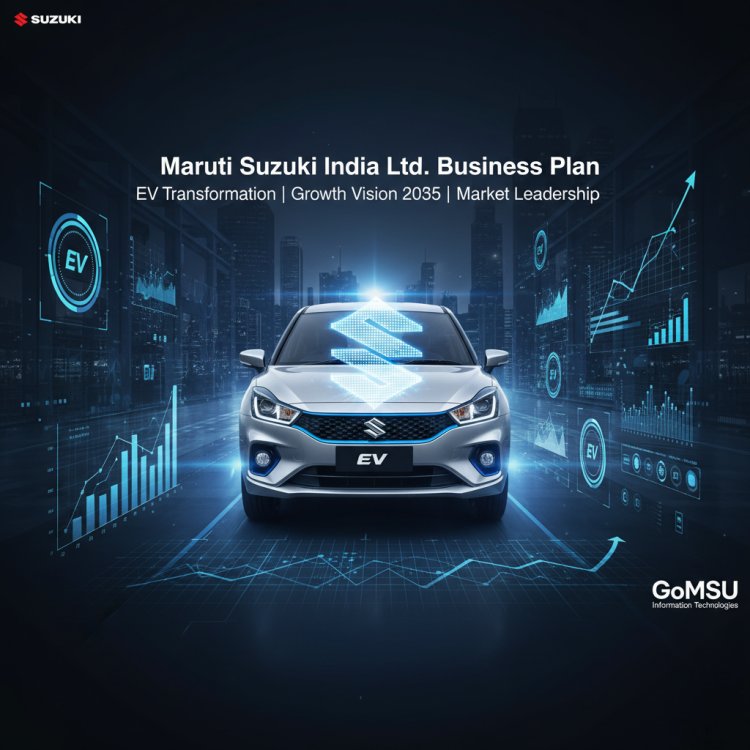
From Fuel to Future: Maruti Suzuki’s Bold Blueprint for India’s Next Auto Era
Inside Maruti Suzuki’s Billion-Dollar Strategy: The Future of India’s Auto Empire Discover how Maruti Suzuki India Ltd., the nation’s most trusted automobile brand, is shaping the future of mobility. This in-depth business plan reveals Maruti Suzuki’s vision for EV transformation, global expansion, and digital innovation through 2035. From cutting-edge R&D investments to market diversification, learn how India’s automotive giant plans to maintain its leadership in a fast-evolving global landscape. ???? Meta Description (for SEO tag): Explore Maruti Suzuki India Ltd.’s billion-dollar business plan driving India’s automotive future. Learn how the company’s EV strategy, sustainability goals, and innovation roadmap are redefining market leadership and setting global benchmarks for the next decade. Maruti Suzuki business plan Maruti Suzuki India Ltd strategy Maruti Suzuki EV roadmap Maruti Suzuki growth plan 2


Key Highlights:
The plan effectively addresses Maruti Suzuki's position as India's automotive leader (40%+ market share) while acknowledging critical challenges like their late entry into the EV market. The strategic focus on five core pillars—EV transformation, digital operations, export growth, cost leadership, and sustainability—provides a balanced approach.
Strengths of the Plan:
- Realistic Targets: 25% EV revenue contribution by 2030 is ambitious yet achievable given India's policy support
- Multi-scenario Planning: Including optimistic, realistic, and conservative projections shows thorough risk assessment
- Comprehensive Analysis: SWOT, PESTEL, and Porter's Five Forces provide solid strategic foundation
- Clear Implementation Timeline: Year-by-year milestones from 2025-2030 enable tracking progress
Areas That Could Be Enhanced:
- Competitive Positioning: While Tata Motors is mentioned as a competitor, they're already ahead in the EV space—the plan could detail specific differentiation strategies
- Charging Infrastructure: The ₹20,000 crore investment mentions charging infrastructure, but lacks specifics on partnerships or deployment strategy
- Technology Partnerships: The Toyota collaboration is mentioned but could be expanded—what specific technologies or platforms will be shared?
- Pricing Strategy: No detail on how EV models will be positioned price-wise to maintain "affordability" advantage
Executive Summary
Maruti Suzuki India Ltd. (MSIL) stands as India’s leading automobile manufacturer, commanding over 40% of the domestic passenger car market. As a subsidiary of Suzuki Motor Corporation (Japan), Maruti Suzuki has built a reputation for affordability, reliability, and widespread service access.
This business plan outlines a forward-looking strategy designed to sustain leadership, embrace electric mobility, and expand global operations. Its scope covers both domestic dominance and global competitiveness, aligning with India’s transformation into a sustainable and digital automotive hub.
The core objectives include:
-
Accelerating the EV transformation journey.
-
Strengthening digital and AI-driven operations.
-
Enhancing export capabilities and global partnerships.
-
Maintaining cost leadership and customer trust through innovation and service quality.
Company Overview & Industry Context
Founded in 1981, Maruti Suzuki revolutionized India’s automobile industry by offering affordable cars tailored for Indian consumers. With production facilities in Gurugram, Manesar, and Gujarat, the company boasts an annual manufacturing capacity exceeding 2.5 million units.
Maruti Suzuki’s brand value continues to dominate through models like Swift, Baleno, WagonR, Alto, Brezza, and Ertiga. Its 3,700+ dealer network and 6,000+ service touchpoints ensure unmatched nationwide reach.
Globally, the automotive industry is transitioning toward electrification, automation, connectivity, and shared mobility. In India, EV adoption is rising under government initiatives like FAME-II and Green Mobility Vision 2030, creating opportunities for Maruti Suzuki to lead through EV innovation and localization.
Market & Competitor Analysis
Core Competitors:
-
Hyundai Motors India
-
Tata Motors
-
Mahindra & Mahindra
-
Kia India
-
MG Motors
SWOT Analysis:
Strengths: Brand reputation, cost efficiency, dealer reach.
Weaknesses: Late entry into EV market, limited premium models.
Opportunities: EV policy incentives, exports to Africa and ASEAN, connected car technology.
Threats: Competitive EV pricing, fluctuating raw material costs, emission regulations.
PESTEL Summary:
-
Political: FAME-II subsidies, Make in India initiatives.
-
Economic: Rising disposable income, fluctuating fuel costs.
-
Social: Preference for compact and fuel-efficient cars.
-
Technological: Advancements in EV batteries and connected features.
-
Environmental: Push for zero-emission vehicles.
-
Legal: Strict emission norms (BS-VI & EV compliance).
Porter’s Five Forces:
-
High rivalry among established players.
-
Moderate threat from substitutes (public transport, shared mobility).
-
Supplier power is moderate due to vendor diversification.
-
Buyer power is increasing due to online comparisons.
-
High entry barriers protect incumbents.
Business Model & Value Proposition
Maruti Suzuki’s business model integrates mass production, affordability, and reliability. Its revenue streams include car sales, service parts, exports, and financing partnerships (Maruti Suzuki Smart Finance).
Customer Segments: Middle-class families, first-time buyers, fleet owners, and rural consumers.
Supply Chain Efficiency: Strong local vendor ecosystem and just-in-time manufacturing minimize costs.
Strategic Partnerships:
-
Suzuki Motor Corporation (R&D, EV technology)
-
Toyota (hybrid and EV collaboration)
Future-Ready Model: Transition to EV and hybrid vehicles with AI-based predictive maintenance, connected car services, and eco-friendly production systems.
Strategic Goals & Growth Opportunities (2025–2035)
-
EV Leadership: Launch five new EV models by 2030 under the “Green Mobility Mission.”
-
Export Expansion: Target emerging markets in Africa, Latin America, and Southeast Asia.
-
Rural Penetration: Strengthen presence with affordable compact models and digital dealerships.
-
Digital Transformation: Implement cloud-based analytics and smart CRM systems.
-
Sustainability Commitment: Achieve carbon neutrality in operations by 2035.
Operational Strategy
-
Localization: Increase local sourcing to 95% to enhance cost efficiency.
-
Industry 4.0: Introduce IoT, AI, and robotic process automation in manufacturing.
-
Vendor Development: Establish training and performance systems for Tier-1 suppliers.
-
Lean Manufacturing: Reduce waste, optimize logistics, and improve energy efficiency.
Marketing & Branding Strategy
-
Digital-First Approach: Leverage social media, online bookings, and virtual showrooms.
-
Influencer Marketing: Collaborate with automotive YouTubers and lifestyle creators.
-
AI Personalization: Offer AI-driven purchase recommendations and service reminders.
-
Youth Branding: Reposition Maruti as a tech-savvy, sustainable, and aspirational brand.
Financial Plan & Projections
Projected Sales Growth (2025–2035): CAGR of 6–8%.
EV Market Contribution: 25% of total revenue by 2030.
Capital Investment: ₹20,000 crore in EV development and charging infrastructure.
ROI Projection: Positive return within 5 years through hybrid and EV adoption.
Scenarios:
-
Optimistic: 10% EV penetration, export growth of 15%.
-
Realistic: 7% EV penetration, export growth of 10%.
-
Conservative: 5% EV penetration with gradual hybrid adoption.
Risk Assessment & Mitigation
| Risk | Impact | Mitigation |
|---|---|---|
| EV adoption delay | Medium | Accelerate R&D and supplier readiness |
| Raw material cost surge | High | Long-term contracts with vendors |
| Regulatory changes | Medium | Proactive policy monitoring |
| Tech disruption | High | Continuous innovation partnerships |
| Economic downturn | Medium | Diversified product portfolio |
Implementation Roadmap (2025–2030)
| Year | Milestone |
|---|---|
| 2025 | Launch first EV model, expand vendor localization |
| 2026 | Digitalize entire dealership network |
| 2027 | Open EV-exclusive showrooms |
| 2028 | Increase exports by 20% |
| 2029 | Carbon-neutral production at Gujarat plant |
| 2030 | Achieve 25% EV revenue share |
Conclusion & Strategic Outlook
Maruti Suzuki India Ltd. is poised to redefine the future of mobility by combining affordability, technology, and sustainability. Through its robust market presence, visionary R&D, and adaptive business strategy, the company will continue to drive India’s automotive transformation and emerge as a global EV pioneer.
Investors and stakeholders are encouraged to collaborate with Maruti Suzuki to capitalize on emerging opportunities in the evolving mobility landscape.
???? Powered by GoMSU Information Technologies
At GoMSU Information Technologies, we help businesses scale through digital automation, data-driven marketing, and intelligent tools.
???? Exclusive Offer for Automotive Businesses
If you choose our Social Media Management Services (₹5,000 per app/month):
-
Get POS, IMS, and CRM tools FREE for 3 months when you subscribe for 5 or more apps.
-
Empower your brand with smart analytics, automated marketing, and business process efficiency.
???? Let’s Connect
???? Email: support@gomsuinfotech.com
???? Website: www.gomsuinfotech.com
???? Call Us: +91-XXXXXXXXXX
???? Visit: GoMSU Information Technologies Pvt. Ltd., Bengaluru, India
GoMSU – Transforming Businesses with Smart Digital Solutions.
What's Your Reaction?