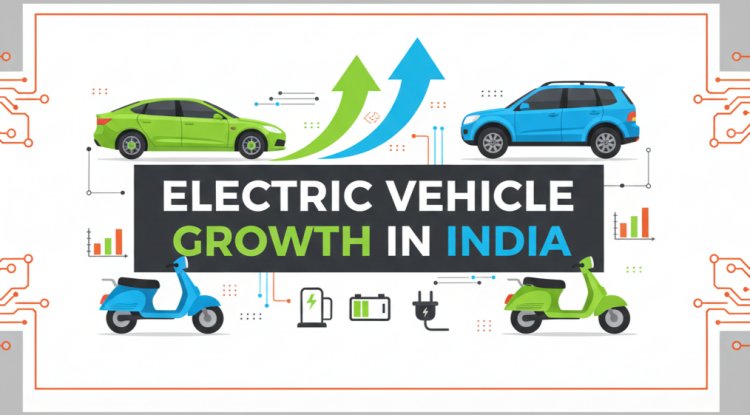
Electric Vehicle Growth in India
Business Opportunities Beyond Automobiles

Introduction: Why Everyone Is Talking About EVs, Yet Missing the Bigger Picture
When people hear the words electric vehicles in India, their minds immediately jump to cars, bikes, batteries, and charging stations. Media headlines reinforce this narrow lens daily. Government policies appear to focus on manufacturing. Startups chase vehicle innovation. Consumers debate range and pricing.
But this is only the visible surface.
The real transformation triggered by India’s electric vehicle revolution is happening quietly in the background. It is reshaping business models, employment structures, data systems, supply chains, education, retail, and enterprise software adoption.
Electric vehicles are not just an automotive shift. They represent a systemic economic shift.
This blog explores the business opportunities created by EV growth beyond automobiles, nationally and internationally, and explains why companies that understand this shift early will dominate the next decade. It also reveals how digital infrastructure like POS, CRM, LMS, and HRMS platforms are becoming critical enablers for businesses operating within the EV ecosystem.
If you are a business owner, entrepreneur, investor, policymaker, or professional, this is not optional reading. It is strategic intelligence.
India’s EV Growth: A Macro View of the Opportunity
India’s electric vehicle market is projected to grow at a compound annual growth rate exceeding 40 percent through the next decade. Government initiatives such as FAME, PLI schemes, state-level subsidies, and infrastructure investments are accelerating adoption.
But what truly matters is intent.
India is not experimenting with EVs. It is committing to them.
Urban pollution concerns, oil import dependency, global climate commitments, and energy security are forcing structural change. As a result, EV adoption is influencing policy decisions far beyond transportation.
This is where businesses must zoom out.
Because whenever a sector becomes policy-backed, long-term opportunities emerge across adjacent industries.
Opportunity 1: Charging Infrastructure as a Service Business
Charging stations are often discussed as physical assets. What is rarely discussed is the service layer built around them.
Charging is not a one-time transaction. It is a repeat behavior.
This creates opportunities in:
-
Subscription-based charging models
-
Fleet charging management services
-
Location analytics and usage optimization
-
Payment processing and loyalty programs
Each charging point behaves like a micro retail outlet. Businesses operating charging networks require POS systems to manage transactions, dynamic pricing, and real-time reporting. Without structured POS data, scaling charging operations becomes chaotic.
This is where businesses naturally begin searching for enterprise-grade POS solutions that integrate billing, reporting, and customer insights seamlessly.
Opportunity 2: EV Fleet Management and Logistics Transformation
Electric vehicles are rapidly entering logistics, last-mile delivery, ride-hailing, and corporate fleets.
This shift creates a new category of businesses focused on:
-
Fleet optimization
-
Predictive maintenance
-
Route intelligence
-
Energy usage analytics
Managing EV fleets is fundamentally different from managing fuel-based fleets. Data becomes the backbone.
Companies managing fleets must track vehicle health, driver behavior, charging schedules, compliance records, and customer delivery metrics. This naturally pushes businesses toward CRM platforms that centralize customer data and HRMS systems that manage drivers, technicians, and operational staff.
EV fleet businesses that fail to digitize operations struggle to scale. Those that adopt structured systems grow faster, attract funding easier, and gain regulatory trust.
Opportunity 3: Battery Lifecycle Management and Second-Life Markets
Batteries are not disposable assets. They are reusable economic resources.
As EV adoption grows, new businesses are emerging in:
-
Battery leasing
-
Battery health diagnostics
-
Recycling and material recovery
-
Second-life battery applications for energy storage
These businesses operate at the intersection of manufacturing, services, and compliance.
They require:
-
Inventory tracking
-
Vendor relationship management
-
Compliance documentation
-
Workforce skill management
At this stage, many businesses realize spreadsheets are insufficient. They begin exploring integrated CRM and HRMS solutions to manage vendor contracts, employee certifications, and regulatory reporting.
This is a subtle but powerful software-driven opportunity created indirectly by EV growth.
Opportunity 4: Skill Development, Training, and EV Education Ecosystem
Electric vehicles require a workforce with entirely new skills.
Traditional mechanics cannot service EVs without retraining. Engineers need upskilling in battery systems, power electronics, and software diagnostics. Sales teams must understand government subsidies, total cost of ownership, and sustainability metrics.
This has created massive demand for:
-
EV training institutes
-
Corporate upskilling programs
-
Online certification platforms
-
Industrial training partnerships
Here, LMS platforms become critical.
Training providers and corporations alike need learning management systems to deliver courses, track progress, assess certifications, and maintain compliance records. Businesses entering the EV education space quickly realize that scalable training is impossible without structured LMS infrastructure.
This is another example of how EV growth fuels enterprise software demand beyond automobiles.
Opportunity 5: EV Retail, Experience Centers, and Omnichannel Sales
EVs are changing how products are sold.
Experience centers are replacing traditional dealerships. Online booking, virtual demos, subscription ownership, and doorstep delivery are becoming standard.
This creates opportunities for:
-
EV-focused retail chains
-
Experience center franchising
-
Subscription-based mobility services
-
Cross-selling energy and insurance products
These businesses operate in omnichannel environments where customer experience defines success.
Here, CRM systems become the core engine. They track customer interactions, preferences, test drives, follow-ups, and post-sales engagement. POS systems handle transactions across physical and digital touchpoints.
Companies that integrate CRM and POS effectively build long-term customer relationships rather than one-time sales.
The Psychological Shift: Why EV Businesses Think Differently
One reason EV-driven businesses scale faster is mindset.
EV adoption attracts future-focused founders. These entrepreneurs are more open to data-driven decisions, automation, and digital tools.
Psychologically, EV businesses are built with scalability in mind from day one. They expect growth, regulation, audits, and expansion. As a result, they invest earlier in structured systems like HRMS for workforce management and LMS for training.
This mindset difference explains why EV-adjacent companies often outperform traditional counterparts even with similar resources.
Why Enterprise Software Is the Invisible Winner of the EV Revolution
While headlines celebrate EV manufacturers, the real long-term winners often operate quietly.
Software does not rust. It scales.
As EV ecosystems grow, every business within them generates more data, more compliance requirements, more workforce complexity, and more customer interactions.
This drives organic demand for:
-
POS systems for transaction intelligence
-
CRM platforms for customer lifecycle management
-
HRMS tools for employee governance and compliance
-
LMS solutions for continuous skill development
Businesses may not initially plan to buy enterprise software. But growth forces the decision.
At this stage, decision-makers begin actively searching for reliable, scalable technology partners. This is where companies like Gomsu Information Technologies naturally enter the conversation, offering integrated digital solutions aligned with modern business needs.
International Perspective: How India’s EV Ecosystem Competes Globally
India is not building EV capacity in isolation.
Global supply chains, technology partnerships, and export markets are converging. Indian businesses now serve international clients in:
-
Software development for EV analytics
-
Battery recycling partnerships
-
Fleet management platforms
-
Training and certification services
To compete globally, Indian businesses must meet international standards of data security, compliance, reporting, and workforce governance.
This again reinforces the importance of enterprise-grade systems like CRM, HRMS, and LMS that align with global best practices.
The Risk of Ignoring the Ecosystem Opportunity
Businesses that view EV growth only through the lens of vehicle manufacturing risk missing the real opportunity.
The largest value creation often happens around the core product, not inside it.
Ignoring supporting services, software infrastructure, training, compliance, and data management is a strategic mistake. By the time these gaps become visible, market leaders are already established.
Conclusion: EV Growth Is a Business Mindset Shift, Not a Product Shift
Electric vehicles are not just replacing engines. They are replacing outdated ways of doing business.
They demand transparency, accountability, digital readiness, and continuous learning.
Businesses that align with this mindset early will find themselves ahead of regulation, ahead of competition, and ahead of market expectations.
Whether you operate in logistics, retail, education, software, energy, or services, the EV revolution affects you.
The question is not whether you participate.
The question is whether you participate strategically.
Call to Action
If this blog helped you see electric vehicles from a broader business perspective, share it with your network.
If you have insights, questions, or disagreements, comment and join the discussion.
If you believe Indian businesses must prepare better for the EV-driven future, let your voice be heard.
Like, share, and comment. Conversations create clarity.
What's Your Reaction?