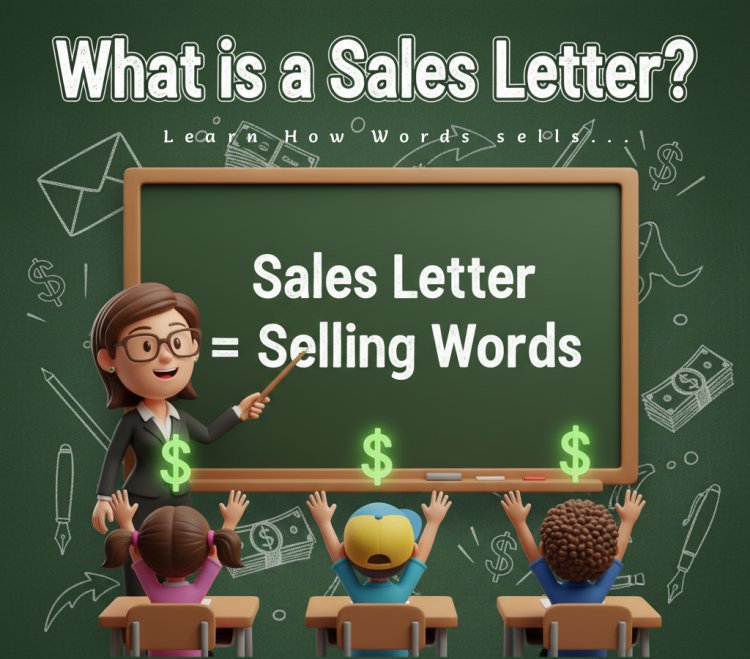
What Is A sales letter ?
You’ve seen ads, emails, and messages persuading you to buy something—but do you know what truly makes them work? That’s the power of a sales letter. In this blog, we break down what a sales letter is, why it’s important in marketing, and how businesses use it to capture attention, build trust, and drive sales.

Sales Letters That Sell: How to Craft Copy That Converts Readers into Customers
A well-written sales letter doesn't just sell—it convinces, engages, and inspires action in readers who never thought they'd buy.
Picture this: A single piece of written copy generates $100 million in sales. No fancy graphics, no videos, no bells and whistles—just words on a page that speak directly to the human heart and wallet.
That's exactly what happened with Gary Halbert's legendary "Coat of Arms" sales letter, which became the most successful direct mail piece in history. But here's the thing—it wasn't magic. It was strategic, psychological mastery of the written word.
After two decades of crafting sales letters that have generated over $500 million in revenue across industries, I've discovered that the difference between copy that converts and copy that collects dust isn't talent—it's understanding human psychology and applying proven formulas.
Today, I'm revealing the exact blueprint that transforms ordinary words into profit-generating machines.
What Is a Sales Letter and Why Does It Still Dominate?
A sales letter is a strategically crafted piece of written communication designed with one laser-focused purpose: to persuade readers to take a specific action. In our digital age, sales letters have evolved beyond traditional direct mail to include email sequences, landing pages, social media posts, and digital marketing campaigns.
But here's what hasn't changed: the fundamental human psychology that makes people say "yes."
Why Sales Letters Remain Marketing's Most Powerful Weapon:
Intimacy at Scale: Unlike mass advertising, a sales letter creates a one-on-one conversation between you and each reader. When someone reads your words, they hear your voice in their head, creating an intimate connection that builds trust and rapport.
Emotional Architecture: Great sales letters don't just inform—they transform. They take readers on an emotional journey from problem awareness to solution excitement, using the power of storytelling to bypass logical objections and connect with deeper motivations.
Compound Leverage: Write once, profit forever. A well-crafted sales letter can work tirelessly for years, generating revenue 24/7 across multiple channels and platforms.
Measurable Precision: Unlike brand awareness campaigns, sales letters provide immediate, quantifiable feedback. You know exactly what's working, what isn't, and how to improve performance with mathematical certainty.
Cost-Effective Scalability: Once you've crafted a converting sales letter, it costs virtually nothing to distribute to thousands of prospects, making it one of the highest ROI marketing activities available.
The 6 Key Elements of a High-Converting Sales Letter
Element 1: The Attention-Grabbing Headline
Your headline is your first impression, your handshake, and your elevator pitch all rolled into one. Studies show that 80% of people read headlines, but only 20% read the rest of your copy. This makes your headline the most critical element of your entire sales letter.
Headline Formulas That Command Attention:
The Curiosity-Driven Headline: "The 37-Second Technique That Doubled My Income While My Competitors Struggled"
The Benefit-Forward Promise: "How to Eliminate Debt Forever Using This Simple 5-Step System"
The Problem-Solution Bridge: "Finally! A Proven Way to Lose Weight Without Giving Up Your Favorite Foods"
The Social Proof Amplifier: "1,847 Small Business Owners Used This Method to Triple Their Revenue in 90 Days"
The Shocking Revelation: "The $2.3 Billion Industry That's Been Hiding This Secret From You"
Pro Tip: Write 25-50 headlines before choosing your winner. The first headline that comes to mind is rarely your best. I've seen headline changes alone increase conversion rates by 300% or more. One client's sales letter went from a 1.2% conversion rate to 4.8% conversion rate with just a headline modification.
Element 2: Problem & Pain Agitation
Once you've captured attention, you need to create emotional investment. This is where you demonstrate deep understanding of your reader's struggles, fears, and frustrations. But here's the key: you're not just identifying problems—you're making them feel urgent and painful.
The Problem Identification Framework:
Surface Problem: What your reader consciously knows they're struggling with. Example: "I need to lose weight."
Deep Problem: The underlying emotional or psychological pain. Example: "I'm embarrassed by how I look and feel invisible in social situations."
Future Problem: What happens if they don't solve this now. Example: "In five years, I'll be even heavier, more isolated, and filled with regret."
The Agitation Process:
Don't just mention problems—paint vivid, uncomfortable pictures that make readers feel the cost of inaction. If you're selling a business solution, don't just say "increase productivity." Instead, write:
"While you're drowning in busywork, watching your competitors race ahead, your best employees are polishing their resumes and your profit margins shrink with each passing quarter. Every day you delay implementing a real solution is another day your business falls further behind—and another sleepless night wondering if you'll still be relevant next year."
The Empathy Bridge:
After agitating the problem, immediately show empathy: "I understand exactly how you feel because I've been there too. That crushing weight of knowing something needs to change but feeling overwhelmed by where to start..."
Element 3: Present Your Solution & Benefits
This is where you transition from problem to solution, but the key is making your product feel inevitable rather than salesy. By the time readers reach this section, they should be thinking, "I need this" rather than "they're trying to sell me something."
The Solution Introduction Pattern:
"After struggling with [problem] for [time period], I discovered something that changed everything. It wasn't [common false solution 1], [common false solution 2], or [common false solution 3]. It was [your unique approach/insight]."
Benefits vs. Features Framework:
Features tell what your product is. Benefits tell what your product does for them. Emotional Benefits tell how it makes them feel.
Instead of: "Our software includes 47 different reporting tools."
Write: "You'll finally have the clear insights you need to make confident decisions, eliminate the guesswork that's been costing you money, and sleep peacefully knowing your business is on the right track."
The Transformation Promise:
Paint a detailed picture of their life after using your solution. Make it specific and emotionally compelling:
"Imagine walking into your office Monday morning energized instead of anxious, checking your dashboard to see steady growth instead of stagnant numbers, and knowing that your business finally runs like the well-oiled machine you always envisioned."
Element 4: Social Proof & Credibility
Humans are inherently social creatures. We look to others for validation before making decisions, especially when money is involved. Social proof in sales letters isn't just helpful—it's essential for overcoming skepticism and building trust.
Types of Social Proof That Convert:
Specific Success Stories: "Maria from Portland increased her monthly revenue from $3,200 to $14,800 in just four months using this system. Here's exactly what she did..."
Volume Validation: "Over 12,847 entrepreneurs across 47 countries have used this method to build profitable businesses."
Expert Endorsements: "'This is the most practical business-building system I've seen in my 20 years as a consultant.' —Dr. James Mitchell, Business Growth Expert"
Before-and-After Transformations: Include specific, measurable results with timeframes and context.
Media Mentions: "As featured in Entrepreneur Magazine, Forbes, and the Wall Street Journal."
Social Proof Placement Strategy:
Weave social proof throughout your sales letter, not just in one dedicated section. Use it to support major claims, overcome specific objections, and reinforce the transformation promise.
Advanced Social Proof Technique: Use "reluctant testimonials" where customers initially had doubts: "I was skeptical at first—I'd tried everything and nothing worked. But within two weeks of implementing this system, I saw results I hadn't experienced in years."
Element 5: Clear & Persuasive Call to Action
A confused mind never buys. Your call to action should be crystal clear, compelling, and create urgency without being pushy. This is where you guide readers from interest to action, from prospect to customer.
Components of a Converting CTA:
Clear Direction: Tell them exactly what to do next. "Click the 'Get Instant Access' button below"
Value Reinforcement: Remind them what they're getting. "...to get the complete system that's helped 2,847 entrepreneurs build profitable businesses"
Risk Reversal: Remove the fear of making a mistake. "Try it risk-free with our 60-day money-back guarantee"
Urgency Element: Give them a reason to act now. "This special pricing expires at midnight Friday"
CTA Psychology Principles:
Use Action Verbs: "Get," "Start," "Access," "Begin," "Join," "Discover"
Make It Feel Small: "Get started" feels less threatening than "Buy now"
Create Movement: "Take the first step toward..." implies a journey rather than a transaction
Remove Friction: "No complicated forms, no credit card required for trial"
Multiple CTA Placement:
Include your call to action multiple times throughout your sales letter:
- After presenting the main benefits
- Following social proof sections
- At natural transition points
- Always at the end
Element 6: Urgency & Scarcity
Without urgency, even interested prospects will procrastinate indefinitely. Urgency transforms interest into action, but it must be authentic and ethical to maintain trust and credibility.
Ethical Urgency Tactics:
Limited Time Bonuses: "Order within the next 48 hours and receive these three bonus programs worth $797 absolutely free..."
Price Increase Deadlines: "This introductory pricing ends Sunday at midnight. After that, the investment increases to the regular price of $497."
Limited Enrollment: "We're only accepting 100 new members this month to ensure personalized support and maximum results."
Seasonal Relevance: "With Q4 approaching, now is the perfect time to implement these strategies before your busiest season."
First-Come, First-Served: "Only the first 50 people to respond will receive the exclusive bonus training session."
The Psychology of Scarcity:
Scarcity works because of loss aversion—people fear missing out more than they desire gaining something. But your scarcity must be real. False urgency destroys credibility and can damage your reputation permanently.
Advanced Urgency Technique: Stack multiple urgency elements: "This limited-time pricing expires Friday, the exclusive bonuses are only available to the first 200 customers, and we're raising prices permanently next month."
Pro Tips for Writing High-Converting Sales Letters
Master the Art of Readability
Short Paragraphs Rule: In the digital age, attention spans are shorter than ever. Keep paragraphs to 1-3 sentences maximum. White space is your friend—it makes your copy feel less overwhelming and more digestible.
Subheadings as Scanners: Many readers will scan before they read. Create compelling subheadings that tell a story on their own and pull readers deeper into your copy.
Bullet Points for Benefits: Use bullet points to highlight key benefits, features, or objections you're addressing. They create visual breaks and make information easier to process.
Harness the Power of Storytelling
The Hero's Journey Framework:
- Ordinary world (relatable starting point)
- Call to adventure (problem emerges)
- Challenges and obstacles (struggles they face)
- Meeting the mentor (finding your solution)
- Transformation (achieving the desired outcome)
Personal Story Integration: Share your own struggles and breakthrough moments. Vulnerability builds connection, and connection builds trust.
"Three years ago, I was $47,000 in debt, working 80-hour weeks, and my marriage was falling apart. I felt like a failure despite all my efforts. Then I discovered the method I'm about to share with you..."
Use Power Words That Trigger Action
Curiosity Words: Secret, hidden, forbidden, confidential, exclusive, insider
Urgency Words: Now, today, immediately, instant, quick, fast, urgent
Value Words: Free, guaranteed, proven, exclusive, limited, breakthrough
Emotional Words: Discover, transform, eliminate, master, unleash, achieve
Test and Optimize Continuously
A/B Testing Elements:
- Headlines and subject lines
- Opening stories and hooks
- Call-to-action placement and wording
- Price presentation and positioning
- Urgency and scarcity elements
Key Metrics to Track:
- Open rates (for email sales letters)
- Read-through rates
- Click-through rates on CTAs
- Conversion rates
- Revenue per visitor
The Testing Mindset:
Never assume you know what will work best. I've been surprised countless times by results that defied conventional wisdom. Sometimes the "weaker" headline wins, sometimes longer copy converts better than shorter copy, sometimes removing urgency improves results.
Let data drive your decisions, not opinions.
Advanced Sales Letter Strategies
The Slippery Slide Technique
Each sentence should compel readers to read the next sentence, like a slippery slide that's impossible to stop sliding down once you start. Achieve this by:
- Ending sentences with intrigue
- Starting new paragraphs with connecting words
- Using open loops that create curiosity gaps
- Transitioning smoothly between ideas
Pattern Interrupts
Break expected patterns to recapture attention:
- Unusual sentence structures
- Unexpected admissions
- Contrarian viewpoints
- Dramatic formatting changes
Example: "I'm going to tell you something my competitors would hate me for sharing..."
The Reason-Why Approach
People need logical justification for emotional decisions. Always provide reasons for your claims, your pricing, your urgency, and your guarantees.
Instead of: "This system works." Write: "This system works because it's based on neuroscience research from Harvard that shows exactly how the brain processes buying decisions."
Common Sales Letter Mistakes That Kill Conversions
The Generic Approach
Writing for "everyone" connects with no one. Successful sales letters speak to a specific person with specific problems and specific desires. The more targeted your message, the more powerfully it resonates.
Feature Dumping
Listing product features without connecting them to emotional benefits. Remember: features tell, benefits sell, but emotions compel.
Weak Openings
Starting with "My name is..." or "Welcome to..." immediately signals "sales pitch" and triggers resistance. Start with impact, intrigue, or insight instead.
No Clear Value Proposition
If readers can't quickly understand exactly what you're offering and why they should care, they'll leave. Your value proposition should be clear within the first few sentences.
Forgettable CTAs
Weak calls to action like "Click here" or "Buy now" waste the momentum you've built. Make your CTA specific, benefit-rich, and action-oriented.
Ignoring Mobile Readers
With over 60% of emails read on mobile devices, your sales letters must be mobile-optimized with short paragraphs, compelling subject lines, and easy-to-tap buttons.
The Future of Sales Letters
While technology evolves rapidly, human psychology remains remarkably consistent. The fundamentals of persuasion—reciprocity, social proof, authority, scarcity, liking, and commitment—haven't changed in thousands of years.
However, modern sales letters are becoming more:
Personalized: Dynamic content that adapts based on reader behavior and preferences Interactive: Elements that engage readers beyond passive consumption Multi-Channel: Coordinated across email, social media, websites, and apps Data-Driven: Continuously optimized based on real-time performance metrics
The businesses that thrive in the coming years will master these fundamentals while embracing new technologies and channels.
Your Sales Letter Action Plan
Ready to create your first high-converting sales letter? Follow this step-by-step roadmap:
Week 1: Research and Foundation
- Define your ideal customer avatar in detail
- Identify their primary pain points and desires
- Research competitor sales letters and messaging
- Gather testimonials and success stories
Week 2: Structure and Strategy
- Choose your primary benefit and unique angle
- Outline your sales letter structure
- Write your headline options (aim for 25-50)
- Plan your social proof integration
Week 3: Writing and Crafting
- Write your first draft without editing
- Focus on emotional connection and benefits
- Incorporate storytelling and social proof
- Create compelling calls to action
Week 4: Testing and Optimization
- Edit for clarity, flow, and persuasion
- Test different headlines and CTAs
- Get feedback from your target audience
- Launch and measure performance
Remember: Your first sales letter won't be perfect, but it will be infinitely better than the one you never write. Every master copywriter started with their first attempt, and every successful business began with someone brave enough to ask for the sale.
The Written Word That Changes Everything
In a world of flashy marketing tactics and trending strategies, the sales letter remains the quiet powerhouse that turns prospects into profits. It's not just about writing—it's about understanding human nature, building genuine connections, and solving real problems with words that matter.
The most successful businesses know this secret: great products need great stories, and great stories need great sales letters to reach the people who need them most.
Your prospects are waiting for someone to understand their struggles, speak their language, and offer them genuine solutions. They're scrolling through countless messages every day, hoping to find something that truly resonates.
Will your sales letter be the one that stops the scroll and starts the sale?
Comment below which sales letter element you think is most critical—or share your favorite tip—and we'll help you craft it for maximum results! Don't forget to like, share, and subscribe to our newsletter to get free knowledge and updates from Gomsu Information Technologies. We provide high-performing business solutions including Social Media Services, Ads Management, Copywriting, Landing Pages, Funnel Mastery, Video Editing, Content Writing, Digital Marketing, Virtual Assistance, Accounting & Tax Support, Legal Drafts, Business Consultations, POS, CRM, LMS, and more—designed to help you grow effortlessly!
The difference between businesses that struggle and businesses that soar often comes down to their ability to communicate value through the written word. Master the art of the sales letter, and you'll have unlocked one of marketing's most powerful and enduring secrets.
What story will your sales letter tell?
What's Your Reaction?