Sonata Software Strategy 2025: A Deep Dive into Its Winning Business Plan
Explore Sonata Software’s Business Plan: a strategic roadmap for global growth, digital transformation, and innovation. Learn how Sonata leverages cloud, AI, and platform solutions to stay ahead in the competitive IT industry.”
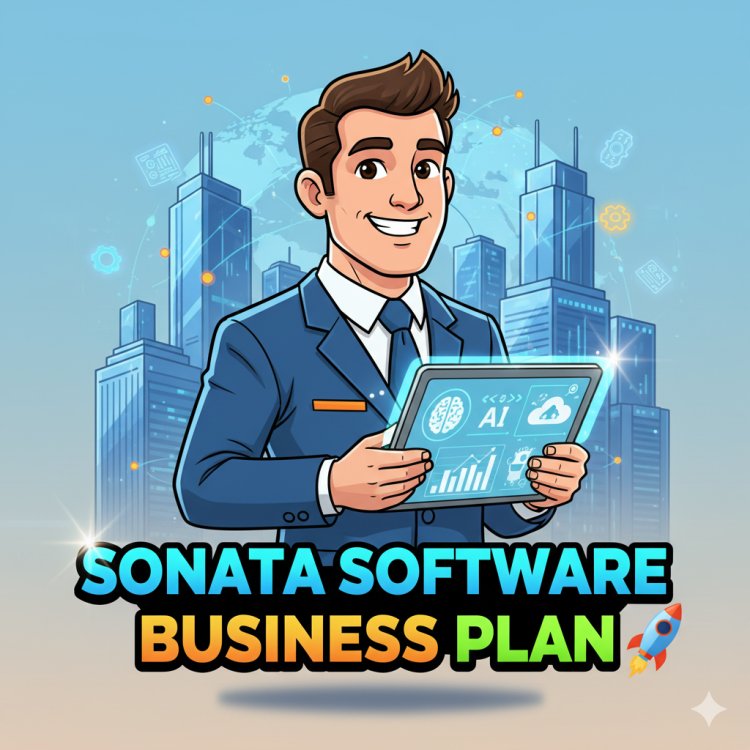

From Humble Beginnings to Global Digital Powerhouse

Picture this: It's 1986, and a small computer-software division within Indian Organic Chemicals is quietly laying the groundwork for what would become one of India's most compelling digital transformation stories. Fast-forward to today, and Sonata Software Limited stands as a testament to strategic vision, calculated pivots, and the power of solving real enterprise pain points.
Born as a division, spun out as an independent entity in 1994, and going public in 1998, Sonata Software's journey from Bengaluru mirrors the evolution of enterprise technology itself. But what makes this story particularly instructive for entrepreneurs, business students, and established enterprises alike isn't just longevity—it's reinvention.
Today, with approximately 6,878 employees spanning global markets and delivering services across analytics, cloud, enterprise applications, mobility, and infrastructure, Sonata represents something more valuable than scale: it represents a proven methodology for navigating the most challenging transition enterprises face today.
The Pivot That Changed Everything
Here's where the story gets interesting for anyone studying business strategy.
For decades, Sonata operated as what industry insiders call a "horizontal" player—providing solid but undifferentiated IT services. Then came 2012. Under the leadership of P. Srikar Reddy as CEO and Managing Director, something fundamental shifted. The company wasn't just going to provide services; it was going to architect transformations.
This wasn't merely rebranding. It was a complete strategic reorientation from service arbitrage (competing on cost) to intellectual property-driven growth (competing on outcomes). The result? Revenue and profits that multiplied several times over, and a market capitalization that grew twentyfold.
Current Managing Director and CEO Samir Dhir now carries this torch forward, bringing deep global delivery and industry expertise to continue Sonata's evolution as a digital transformation leader.
The entrepreneurial lesson here is profound: Sometimes the biggest growth doesn't come from doing more of what you're already doing—it comes from fundamentally redefining what business you're actually in.
The Problem That Keeps Enterprise Leaders Awake
Let's talk about the elephant in every boardroom.
Legacy enterprises face a brutal paradox: They know they need to become agile, cloud-powered, data-driven digital businesses. They know their competitors—or worse, well-funded startups—are eating their lunch. They know delay is dangerous.
But they also know that transformation is treacherous. Move too fast, and you break critical systems. Move too slow, and you become irrelevant. Hire the wrong partners, and you accumulate technical debt that haunts you for years. Make the wrong architectural decisions, and you're locked into expensive, inflexible systems.
This is the nightmare scenario: knowing you must transform while understanding that transformation itself is the risk.
Enter Sonata Software's core value proposition: not just to "do the IT work," but to provide a strategic blueprint that makes transformation faster, less risky, and outcome-oriented. They're not selling code—they're selling confidence in the journey from legacy to digital.
Platformation™: The Framework That Makes the Difference
What separates a service provider from a strategic partner? A framework.
Sonata's proprietary Platformation™ methodology is their secret sauce—a comprehensive 16-step playbook for modernization engineering that transforms how enterprises think about digital transformation. Rather than treating each client engagement as a unique puzzle to solve from scratch, Platformation™ offers a repeatable, scalable approach.
Think of it this way: If traditional IT services are custom carpentry—starting with raw materials each time—Platformation™ is more like advanced manufacturing with proven blueprints, quality controls, and predictable outcomes.
The framework is designed to:
- Move companies from viewing IT as a cost center to leveraging it as a digital growth engine
- Combine cloud architecture, real-time analytics, scalable infrastructure, and deep domain expertise
- Deliver measurable business outcomes: new revenue streams, operational agility, accelerated time-to-market
- Reduce transformation risk through proven patterns and methodologies
For entrepreneurs and startup founders, the lesson is clear: Building a repeatable methodology or framework around your service isn't just operational efficiency—it's your competitive moat. It's what transforms you from a vendor into a strategic partner.
The Power of Strategic Partnerships
Here's another dimension of Sonata's model that deserves attention: their alliance strategy.
Rather than trying to build every capability in-house, Sonata has cultivated deep partnerships with leading cloud providers, enterprise application ecosystems, and technology platforms. These partnerships provide three critical advantages:
- Access to cutting-edge technology: Clients get world-class platforms without Sonata needing to reinvent the wheel
- Credibility and validation: Partnership status with major tech players signals capability and commitment
- Aligned incentives: Technology providers, delivery partners (Sonata), and clients form a three-way value creation engine
Layer on top of this a global delivery model that provides cost efficiency and scale, and you have a potent combination: leading-edge technology, proven delivery methodology, and competitive economics.
Sonata positions itself at a powerful intersection—enabling clients to leverage world-class technology and delivery expertise without the risk and expense of building everything from scratch.
The startup insight: You don't have to own every piece of the value chain. Strategic partnerships can dramatically accelerate your capabilities and credibility. The question isn't whether to partner, but how to architect partnerships that create mutual value.
A Story Worth Telling
Frameworks and partnerships are important, but let's bring this to life with a scenario that plays out daily in boardrooms worldwide.
Imagine a major retailer—let's call them "RetailCo"—struggling with legacy inventory systems that can't provide real-time visibility. Manual processes dominate. Decision-making is slow. Competitors with better data and faster response times are gaining market share. The pressure is mounting.
RetailCo's leadership knows they need to modernize, but they're paralyzed by the complexity and risk. Previous IT initiatives have gone over budget and under-delivered. Trust is low.
They engage Sonata. Through Platformation™, Sonata doesn't just migrate systems—they architect a transformation. Cloud-based platforms replace legacy infrastructure. Real-time analytics provide visibility that was never possible before. Agile workflows replace rigid processes. Integration points are carefully designed for future flexibility.
The outcomes tell the story: millions in cost savings, significantly faster time to market for new initiatives, improved customer experience, and RetailCo repositioned as a digital leader in their sector rather than a laggard.
This isn't a hypothetical. This is the pattern that repeats across Sonata's client base—and it's the pattern that entrepreneurs should study carefully.
The narrative structure matters: Problem → Transformation → Measurable Outcome. This is how you demonstrate value, build case studies, and earn the right to the next conversation.
Why This Model Should Inspire You
Whether you're a founder sketching ideas on a napkin, a business student analyzing case studies, or an executive at an established enterprise, Sonata's model offers transferable lessons:
1. Problem-First Orientation
They didn't start with "we're good at coding" or "we have smart engineers." They started with "enterprises face terrifying risk in digital transformation—how do we make that journey safer and more predictable?"
2. Methodology as Differentiator
Platformation™ isn't just marketing speak—it's a genuine intellectual property asset that makes engagements faster, less risky, and more successful. What's your equivalent? What repeatable approach sets you apart?
3. Outcome Focus
Notice the language: not "we'll implement systems," but "we'll unlock revenue, agility, and efficiency." Clients don't buy features; they buy outcomes. How are you framing your value proposition?
4. Leverage, Don't Build Everything
Strategic partnerships amplify capabilities without requiring you to master every domain. What partnerships could accelerate your growth?
5. Proof in Growth
Sonata's own transformation—revenue and profit multiplication, 20x market cap growth—provides credibility. Your track record of delivering for clients becomes your most powerful marketing.
6. Talent and Opportunity Engine
With nearly 7,000 employees globally and active hiring across cloud engineering, analytics, consulting, and delivery, Sonata demonstrates that transformation-focused businesses create meaningful career opportunities. For students: this is where the jobs are. For entrepreneurs: this is where you can build teams around meaningful work.
The Digital Transformation Economy
We're living through a fundamental shift in how businesses operate. Platform economies, cloud-first strategies, real-time data-driven decision-making, and agile methodologies aren't future trends—they're current requirements.
Yet the gap between aspiration and execution remains enormous. According to various industry studies, the majority of digital transformation initiatives fail to meet their objectives. Enterprises know what they want but struggle mightily to get there.
This is where Sonata's role becomes clear: they're the bridge between vision and reality. They're the translators who speak both business strategy and technology architecture. They're the risk mitigators who have seen the pitfalls and know how to avoid them.
From an employment and talent development perspective, this creates rich opportunities. Sonata's career page highlights global openings in cloud engineering, analytics, agile delivery, and consulting. They emphasize diversity and inclusion, with targeted initiatives for women in technology.
For students: The skills to develop aren't just coding—they're transformation engineering, cloud architecture, agile delivery, and business consulting. Learn to speak the language of business outcomes, not just technical specifications.
For entrepreneurs: There's enormous demand for platforms, frameworks, and transformation services. You don't need to compete with Sonata directly—you can carve out a niche, a vertical, a methodology, or a technology specialization within the broader transformation economy.
Competitive Intelligence and Benchmarking
If you're analyzing the competitive landscape or benchmarking your own organization, here are the data points worth noting about Sonata:
- Founded: 1986 (nearly four decades of institutional knowledge)
- Global workforce: ~6,878 employees as of FY 2024-25
- Geographic footprint: Delivery presence across Americas, Europe, and Asia-Pacific
- Strategic inflection point: 2012 leadership change that pivoted from horizontal services to IP-driven platform engineering
- Service focus: Cloud, enterprise applications (ERP/CRM), analytics, mobility, infrastructure
- Differentiation: Proprietary Platformation™ framework, strong technology partnerships, global delivery model
Map your organization against these dimensions. Where do you have advantages? Where are the gaps? What can you learn from their strategic choices?
Your Call to Action
Let's make this practical. Here's what you should do next, depending on who you are:
If You're a Startup Founder:
- Question 1: What legacy problem are you solving? Is it painful enough that enterprises will pay to solve it?
- Question 2: Do you have a framework or methodology (your "Platformation™"), or are you just providing ad-hoc services?
- Question 3: Who are your strategic partners, and how do they amplify your capabilities?
- Question 4: Can you articulate measurable business outcomes, not just technical deliverables?
If You're a Business Student:
- Exercise: Map Sonata's business model as a case study: Problem Definition → Strategic Framework → Technology Partnerships → Global Delivery → Measurable Outcomes → Growth. Analyze how each element depends on the others.
- Research: Compare Sonata's model to other IT services firms. What makes platform-based transformation different from traditional consulting or staff augmentation?
- Career Planning: What skills do transformation-focused companies value? How can you position yourself for these opportunities?
If You're an Enterprise Executive:
- Benchmarking: How does your internal IT capability compare to what partners like Sonata offer? Where should you build, and where should you partner?
- Vendor Evaluation: When assessing transformation partners, look for methodology (not just case studies), technology partnerships (not just claims), and outcome focus (not just activity metrics).
- Talent Strategy: Are you developing transformation skills internally, or are you dependent on external partners for strategic thinking?
The Blueprint for Digital Leadership
Sonata Software's story is more than a company profile—it's a blueprint for thriving in an era where technology isn't just a support function but the very foundation of competitive advantage.
The model works because it:
- Solves an urgent, widespread pain point: Legacy-to-digital transformation with acceptable risk
- Provides a proven methodology: Platformation™ as a repeatable framework
- Leverages strategic partnerships: World-class technology without reinventing everything
- Demonstrates consistent results: Growth trajectory that validates the approach
- Creates tangible value: Real stories of revenue growth, cost reduction, and competitive repositioning
Whether you're building a startup, studying business strategy, or leading an established enterprise, the fundamental questions remain the same:
What is your "Platformation™"? What repeatable methodology sets you apart?
What blueprint will you build? What framework makes your offering predictable and scalable?
What pain point will you solve? Is it urgent enough, expensive enough, risky enough that clients will pay for a solution?
How will you partner and scale? What strategic alliances amplify your capabilities?
These aren't rhetorical questions. They're the foundation of sustainable competitive advantage in the digital age.
The enterprises that figure this out—whether they're 38 years old like Sonata or just getting started—won't just survive the digital transformation era. They'll lead it.
Now it's your turn. What will you build?
Founded in 1986 and headquartered in Bengaluru, India, Sonata Software Limited provides digital transformation services globally through its proprietary Platformation™ framework. With approximately 6,878 employees worldwide, the company serves enterprises across cloud, analytics, enterprise applications, and infrastructure modernization.
What's Your Reaction?