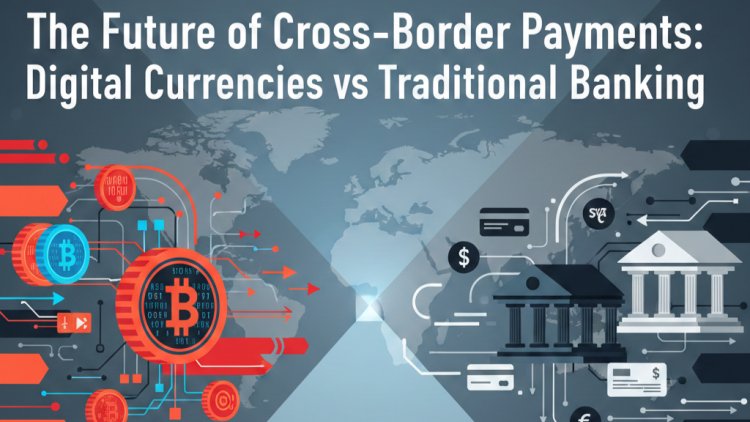
The Future of Cross-Border Payments: Digital Currencies vs Traditional Banking
Cross-border payments are changing fast. Discover how digital currencies compare with traditional banking, what the future holds for global businesses, and how companies can stay ahead.

Introduction: Why Sending Money Across Borders Is Still a Problem
Sending money across borders should be simple.
But in reality, it is slow, expensive, and confusing.
Businesses wait days for payments. Fees eat into profits. Exchange rates change without warning. Documentation becomes a nightmare.
At the same time, digital currencies and new payment technologies are promising faster, cheaper, and smarter solutions.
This blog explains, in very simple words, how cross-border payments are evolving, the battle between digital currencies and traditional banking, and what businesses must prepare for next.
What Are Cross-Border Payments
Cross-border payments happen when money moves from one country to another.
Examples include:
-
An Indian company paying a supplier in Europe
-
A US client paying a freelancer in Asia
-
A global business paying salaries across countries
These payments involve multiple banks, currencies, regulations, and systems.
That is why they are slow and costly.
Traditional Banking: How It Works Today
Traditional cross-border payments rely on correspondent banking.
This means:
-
Your bank sends money to another bank
-
That bank may involve another intermediary
-
Each intermediary charges a fee
-
Each step takes time
Problems with traditional banking:
-
High transaction fees
-
Slow settlement time
-
Limited transparency
-
Currency conversion losses
-
Manual compliance processes
For decades, businesses had no alternative.
But that is changing now.
Digital Currencies: A New Way to Move Money
Digital currencies use technology to transfer value directly.
They include:
-
Central Bank Digital Currencies (CBDCs)
-
Stablecoins
-
Blockchain-based payment networks
These systems reduce intermediaries and automate processes.
What makes digital currencies attractive:
-
Faster transfers
-
Lower fees
-
Real-time tracking
-
Fewer middlemen
-
Programmable payments
For global businesses, this is a big shift.
CBDCs: Governments Enter the Digital Payments Space
Many countries are developing Central Bank Digital Currencies.
CBDCs are:
-
Issued by governments
-
Regulated and stable
-
Designed to improve payment efficiency
They aim to modernize cross-border payments while keeping control within the financial system.
For businesses, CBDCs could mean:
-
Faster international settlements
-
Reduced currency risk
-
Improved compliance
Digital Currencies vs Traditional Banking: Simple Comparison
Speed
Traditional banking takes days
Digital currencies work in minutes or seconds
Cost
Traditional banking charges high fees
Digital currencies reduce transaction costs
Transparency
Traditional banking lacks visibility
Digital currencies offer real-time tracking
Compliance
Traditional banking relies on manual checks
Digital currencies use automated rules
Why Businesses Are Paying Attention Now
Global trade is growing.
Remote work is increasing.
International freelancing is booming.
Businesses need faster and more reliable payment systems.
Delayed payments affect:
-
Cash flow
-
Supplier relationships
-
Employee trust
-
Customer satisfaction
Cross-border payment efficiency is no longer optional.
The Compliance Challenge Nobody Talks About
Faster payments bring new risks.
Governments worry about:
-
Money laundering
-
Tax evasion
-
Fraud
-
Data security
This is why regulations are increasing.
Businesses must ensure:
-
Transaction traceability
-
Accurate records
-
Proper reporting
-
Data protection
Technology must support compliance, not bypass it.
Role of Business Systems in Modern Payments
Cross-border payments do not work in isolation.
They are connected to sales, HR, training, and customer data.
That is where integrated systems matter.
CRM Systems and International Customer Payments
When payments cross borders, customer data must be accurate and secure.
CRM systems help businesses:
-
Track international customers
-
Manage billing information
-
Record payment histories
-
Maintain data transparency
Clean CRM data reduces disputes and compliance issues.
HRMS and Global Payroll Payments
Companies with international teams face payment complexity.
HRMS platforms help manage:
-
Cross-border salary payments
-
Compliance records
-
Employee data security
-
Payment documentation
As global payroll faces more regulation, structured HRMS systems become critical.
LMS and Financial Compliance Awareness
Employees handling payments must understand regulations.
LMS platforms help businesses:
-
Train teams on payment compliance
-
Educate about digital currency risks
-
Reduce human errors
-
Maintain audit-ready learning records
Training protects businesses more than policies alone.
POS Systems and International Transactions
Retailers and service providers handling international customers need accurate transaction records.
POS systems ensure:
-
Real-time transaction data
-
Currency clarity
-
Clean reporting
-
AI-ready analytics
This supports both traditional and digital payment models.
How Gomsu Information Technologies Supports Global Payment Readiness
Gomsu Information Technologies builds systems that help businesses operate confidently in a cross-border environment.
Gomsu CRM
Ensures customer payment data is structured, traceable, and compliant across regions.
Gomsu HRMS
Simplifies global workforce payments with transparent records and compliance-ready workflows.
Gomsu LMS
Trains teams on digital payment systems, financial rules, and compliance awareness.
Gomsu POS
Manages international transactions with accuracy and real-time insights.
Gomsu tools prepare businesses for both traditional banking and digital currency ecosystems.
Psychological Insight: Businesses Fear Uncertainty, Not Change
Most businesses do not resist digital currencies.
They resist confusion.
When systems are clear, documented, and secure, adoption becomes easy.
Clarity builds confidence.
Confidence drives innovation.
What the Future Looks Like
The future will not eliminate banks.
It will combine:
-
Traditional banking
-
Digital currencies
-
Automated compliance
-
Integrated business systems
Businesses that prepare early will benefit most.
Conclusion: Payments Will Become Invisible, Strategy Will Not
In the future, payments will be instant and invisible.
What will matter is how businesses manage data, compliance, and trust.
Digital currencies are not replacing traditional banking overnight.
They are reshaping it.
Companies that adapt now will lead tomorrow.
Call to Action
If this blog helped you understand the future of cross-border payments, share it with your team.
Comment your thoughts or questions below.
Like, share, and engage.
Smart conversations build smart businesses.
What's Your Reaction?