How Middle East Conflicts Are Affecting Oil Prices and Global Businesses
Middle East conflicts are driving oil price volatility worldwide. Learn how this impacts global businesses, supply chains, costs, and how companies can prepare strategically.
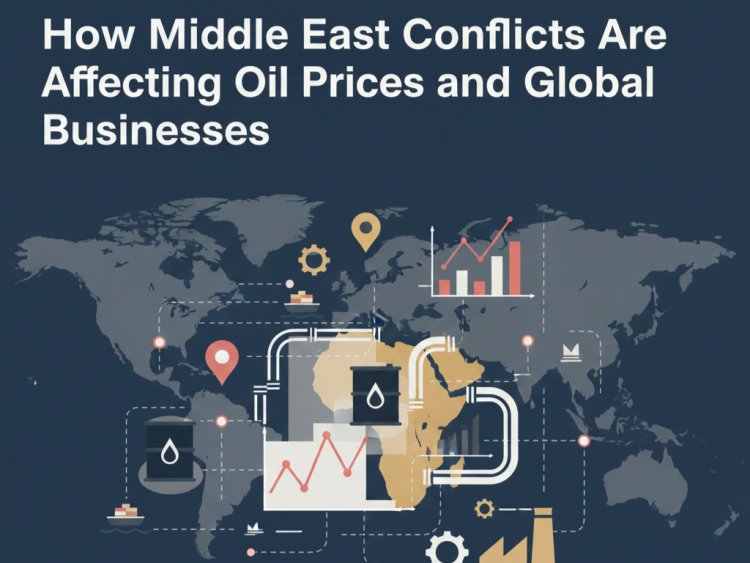

Introduction: Why a Conflict Far Away Affects Your Business Today
Many business owners ask one simple question.
Why do oil prices rise when there is conflict in the Middle East?
The answer is simple.
Because the Middle East is the heart of the global energy system.
When instability hits this region, the entire world feels it. Fuel prices rise. Transportation costs increase. Manufacturing becomes expensive. Inflation follows.
Even businesses that never deal with oil directly are affected.
This blog explains, in very easy language, how Middle East conflicts influence oil prices, why global businesses suffer the consequences, and how companies can prepare instead of reacting in panic.
Why the Middle East Matters So Much in Oil Markets
The Middle East holds a major share of the world’s oil reserves.
Countries like:
-
Saudi Arabia
-
Iran
-
Iraq
-
United Arab Emirates
-
Kuwait
Supply oil to nearly every region of the world.
When conflicts occur in or around these countries, markets fear supply disruption.
Fear alone is enough to push prices up.
How Conflicts Increase Oil Prices
Oil prices do not rise only when supply stops.
They rise when supply is at risk.
Conflicts create:
-
Threats to oil fields
-
Risks to shipping routes
-
Sanctions and trade restrictions
-
Political uncertainty
Traders respond instantly.
Prices increase before real shortages even happen.
The Strait of Hormuz: A Small Route With Huge Impact
One of the most critical areas is the Strait of Hormuz.
A large portion of the world’s oil passes through this narrow route.
Any conflict near this area creates panic in energy markets.
Even rumors can move prices sharply.
This shows how sensitive global oil prices are to geopolitical tensions.
Immediate Impact on Global Businesses
When oil prices rise, businesses feel it quickly.
Fuel becomes expensive. Transportation costs increase. Electricity prices rise.
This affects:
-
Logistics companies
-
Manufacturers
-
Airlines
-
Retailers
-
Service providers
Costs rise across the supply chain.
Hidden Impact: Inflation and Reduced Consumer Spending
Higher oil prices increase inflation.
When inflation rises:
-
Daily essentials become expensive
-
Consumers spend less
-
Demand slows down
Businesses then face a double challenge:
-
Higher operational costs
-
Lower customer spending
This combination is dangerous if not managed properly.
Impact on Manufacturing and Supply Chains
Manufacturing depends heavily on energy.
Higher oil prices increase:
-
Production costs
-
Raw material transportation costs
-
Export expenses
Global supply chains become slower and costlier.
Companies relying on long-distance sourcing are hit hardest.
Impact on Small and Medium Businesses
Large corporations can absorb shocks.
Small and medium businesses cannot.
They face:
-
Reduced profit margins
-
Cash flow pressure
-
Pricing challenges
-
Delayed expansion plans
Without strong systems, many struggle to survive prolonged volatility.
Why Businesses Need Better Operational Control During Uncertainty
Uncertain times expose weak systems.
Businesses need clarity in:
-
Cost tracking
-
Sales performance
-
Workforce productivity
-
Customer behavior
Guesswork leads to losses.
Data-driven decisions protect stability.
Role of POS Systems During Price Volatility
POS systems help businesses:
-
Track real-time sales
-
Monitor pricing impact
-
Analyze customer demand changes
-
Manage inventory efficiently
When oil-driven inflation hits, POS data helps businesses adjust pricing wisely instead of blindly increasing rates.
CRM Systems and Customer Retention in Tough Times
When prices rise, customer loyalty becomes critical.
CRM systems help businesses:
-
Understand customer behavior
-
Track purchasing patterns
-
Improve communication
-
Retain high-value customers
During economic pressure, retention matters more than acquisition.
HRMS: Managing Workforce Costs Smartly
Rising costs often force businesses to rethink workforce expenses.
An HRMS system helps:
-
Track employee productivity
-
Manage payroll efficiently
-
Control overtime and absenteeism
-
Maintain compliance
Gomsu HRMS gives businesses visibility and control over workforce data, helping them balance costs without damaging morale.
LMS: Preparing Employees for Change
Uncertain markets require adaptable teams.
Employees must understand:
-
Cost sensitivity
-
Process efficiency
-
Resource optimization
An LMS helps businesses:
-
Train teams quickly
-
Improve efficiency
-
Reduce errors
-
Align employees with new strategies
Learning reduces fear and confusion.
How Gomsu Information Technologies Supports Business Stability
Gomsu Information Technologies builds tools that help businesses stay strong during global uncertainty.
Gomsu POS
Provides real-time sales insights and pricing clarity.
Gomsu CRM
Strengthens customer relationships during economic pressure.
Gomsu HRMS
Helps manage workforce costs, compliance, and productivity.
Gomsu LMS
Trains teams to adapt quickly to changing conditions.
These tools do not remove external risks.
They reduce internal chaos.
Psychological Insight: Businesses Fail Due to Panic, Not Problems
Most businesses do not fail because oil prices rise.
They fail because leaders panic.
Panic leads to:
-
Poor decisions
-
Cost-cutting without strategy
-
Employee disengagement
-
Customer loss
Systems create calm.
Calm creates better decisions.
What Smart Businesses Are Doing Now
Successful businesses are:
-
Tracking costs closely
-
Diversifying suppliers
-
Improving operational efficiency
-
Investing in digital systems
-
Training employees for adaptability
Preparation always beats prediction.
What the Future Looks Like
Middle East tensions may continue.
Oil prices will remain volatile.
Businesses must accept uncertainty as the new normal.
The winners will be those who build:
-
Flexible systems
-
Strong data visibility
-
Skilled teams
Conclusion: You Cannot Control Oil Prices, But You Can Control Readiness
Middle East conflicts will continue to influence oil markets.
No business can stop that.
But every business can control how prepared it is.
Strong systems, trained people, and clear data turn uncertainty into manageable risk.
Call to Action
If this blog helped you understand how global conflicts affect oil prices and businesses, share it with your team.
Comment your thoughts or experiences below.
Like, share, and engage.
Awareness is the first step toward resilience.
What's Your Reaction?