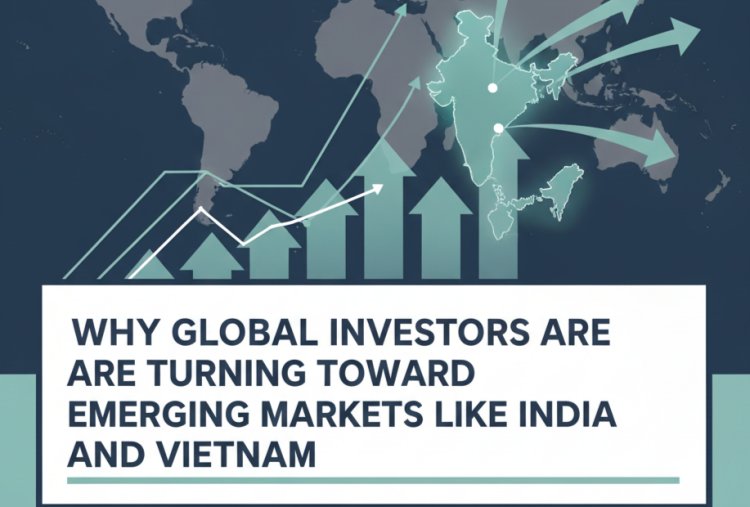
Why Global Investors Are Turning Toward Emerging Markets Like India and Vietnam
Global investors are shifting toward emerging markets like India and Vietnam. Explore the real reasons behind this trend, opportunities, risks, and how businesses can prepare.

Introduction: Money Always Moves Where the Future Looks Safer
Investors are not emotional.
They follow patterns.
They study risk, growth, stability, and long-term opportunity. When capital starts moving in one direction globally, it is never random.
Over the last few years, global investors have been quietly changing their focus.
Instead of concentrating only on developed economies, they are increasingly turning toward emerging markets, especially countries like India and Vietnam.
This shift is not driven by hype.
It is driven by fundamentals.
This blog explains, in very simple language, why global investors are choosing emerging markets, why India and Vietnam are at the center of this shift, what this means for businesses, and how companies can prepare to benefit from this global realignment.
Understanding Emerging Markets in Simple Terms
Emerging markets are countries that are growing fast but are not yet fully developed economies.
They usually have:
-
Young populations
-
Expanding middle classes
-
Growing industries
-
Improving infrastructure
-
Increasing global integration
They may also have challenges, but their growth potential attracts long-term investors.
India and Vietnam fit this profile perfectly.
Why Investors Are Rethinking Developed Markets
For decades, investors focused mainly on the US, Europe, and a few advanced economies.
Today, those markets face challenges:
-
Slower economic growth
-
Aging populations
-
High labor costs
-
High interest rates
-
Saturated consumer markets
Returns are becoming harder to achieve.
Investors are now asking a simple question.
Where will the next decade of growth come from?
India and Vietnam: Two Different Countries, One Powerful Trend
India and Vietnam are very different culturally and politically.
But from an investment perspective, they share strong similarities:
-
Large and young workforce
-
Competitive labor costs
-
Strong manufacturing growth
-
Digital transformation
-
Pro-business policy direction
These factors make them attractive alternatives in global supply chains and investment portfolios.
The China Plus One Strategy and Its Impact
One major driver of this shift is the China Plus One strategy.
Global companies are reducing dependence on a single country for manufacturing.
This is not about abandoning China completely.
It is about reducing risk.
India and Vietnam have become preferred alternatives due to:
-
Manufacturing capacity
-
Political stability
-
Improving logistics
-
Skilled labor availability
This shift brings foreign investment, jobs, and technology transfer.
India’s Advantage: Scale and Demographics
India’s biggest strength is its scale.
-
Over a billion people
-
One of the youngest populations globally
-
Rapid urbanization
-
Expanding consumer demand
For investors, this means:
-
Long-term consumption growth
-
Talent availability
-
Domestic market stability
India is not just a manufacturing hub.
It is a consumption-driven economy.
Vietnam’s Advantage: Speed and Efficiency
Vietnam offers something different.
-
Faster decision-making
-
Efficient export-oriented manufacturing
-
Strong trade agreements
-
Strategic geographic location
Vietnam has positioned itself as a reliable manufacturing and export base, especially for electronics, textiles, and consumer goods.
For investors seeking operational efficiency, Vietnam is highly attractive.
Political and Policy Stability Matters More Than Ever
Investors value predictability.
Both India and Vietnam have shown:
-
Long-term policy direction
-
Support for foreign investment
-
Infrastructure development focus
-
Ease-of-doing-business improvements
While challenges remain, the overall direction is clear.
Stability attracts capital.
Digital Transformation as an Investment Magnet
Investors today do not invest only in factories.
They invest in systems.
India’s digital infrastructure growth, including:
-
Digital payments
-
Government-backed platforms
-
Startup ecosystems
-
Cloud adoption
Vietnam’s push toward:
-
Smart manufacturing
-
Digital exports
-
Technology parks
These trends reduce operational friction and increase scalability.
What This Shift Means for Global Businesses
When investors move, businesses follow.
This shift means:
-
New manufacturing hubs
-
New hiring locations
-
New customer markets
-
New competition
Companies that adapt early gain cost advantages and market share.
Those that delay face higher entry barriers later.
Workforce Strategy Becomes a Key Decision
Investing in emerging markets requires people.
Businesses must:
-
Hire locally
-
Train quickly
-
Maintain compliance
-
Manage diverse teams
This is where strong HR systems become critical.
Gomsu HRMS: Managing Workforce Growth in Emerging Markets
Gomsu HRMS helps businesses manage growing and distributed workforces with clarity.
Key benefits include:
-
Centralized employee records
-
Structured onboarding
-
Payroll and attendance tracking
-
Compliance-ready documentation
-
Performance monitoring
In fast-growing markets like India and Vietnam, structure prevents chaos.
Why Investors Care About HR Systems
Investors look beyond revenue.
They assess:
-
Operational maturity
-
Workforce stability
-
Compliance readiness
-
Scalability
Companies using HRMS platforms appear more investment-ready.
Systems build confidence.
CRM: Understanding New and Growing Markets
Emerging markets are diverse.
Customer behavior varies by region, income, and culture.
CRM systems help businesses:
-
Track customer preferences
-
Manage regional sales strategies
-
Build long-term relationships
-
Predict demand patterns
Growth without customer insight leads to waste.
POS Systems and Ground-Level Market Intelligence
Retail and service businesses entering India or Vietnam need real-time data.
POS systems provide:
-
Sales trends
-
Pricing sensitivity
-
Inventory movement
-
Regional performance
This helps businesses adjust strategies quickly instead of relying on assumptions.
LMS: Building Skills at Scale
Rapid expansion requires fast learning.
An LMS helps companies:
-
Train local teams
-
Maintain consistent standards
-
Reduce dependency on external consultants
-
Track skill development
With Gomsu LMS, training becomes measurable and repeatable.
Psychological Insight: Investors Invest in Confidence, Not Hope
Investors do not chase stories.
They chase systems, discipline, and execution capability.
Companies that show:
-
Clear processes
-
Strong data
-
Skilled teams
Attract more capital.
Confidence is built internally before it is rewarded externally.
Risks Investors Are Aware Of
Investors are optimistic, not blind.
They monitor:
-
Regulatory changes
-
Infrastructure gaps
-
Talent shortages
-
Currency volatility
Businesses that plan for risks gain long-term trust.
How Smart Businesses Are Positioning Themselves
Forward-thinking companies are:
-
Building local partnerships
-
Investing in digital systems
-
Training local leadership
-
Standardizing operations
-
Preparing for audits and scaling
They treat emerging markets as long-term commitments, not experiments.
Why This Trend Will Continue
Global growth patterns are changing.
Emerging markets will:
-
Drive global consumption
-
Supply global manufacturing
-
Shape innovation
India and Vietnam are positioned at the center of this transformation.
Capital follows momentum.
What Happens to Businesses That Ignore This Shift
Companies that stay focused only on traditional markets face:
-
Slower growth
-
Higher costs
-
Limited expansion options
Emerging markets are not optional anymore.
They are strategic.
How Gomsu Information Technologies Supports Expansion-Ready Businesses
Gomsu Information Technologies provides integrated tools that help businesses grow confidently in emerging markets.
-
Gomsu HRMS for workforce control and compliance
-
Gomsu CRM for customer intelligence
-
Gomsu POS for real-time market data
-
Gomsu LMS for scalable training
Together, these systems turn opportunity into execution.
The Long-Term View Investors Are Taking
Investors are not looking for quick wins.
They are building positions for the next 10 to 20 years.
India and Vietnam offer:
-
Demographic strength
-
Industrial growth
-
Digital readiness
-
Expanding markets
These are not temporary advantages.
Conclusion: Capital Moves Early, Value Is Created Later
Global investors are moving toward emerging markets because the future is being built there.
India and Vietnam represent opportunity, resilience, and scale.
Businesses that prepare now will grow with the wave.
Those that wait will chase it later at a higher cost.
Call to Action
If this blog helped you understand why global investors are focusing on emerging markets like India and Vietnam, share it with your team.
Comment your thoughts or questions below.
Like, share, and engage.
Informed discussion leads to smarter decisions.
What's Your Reaction?