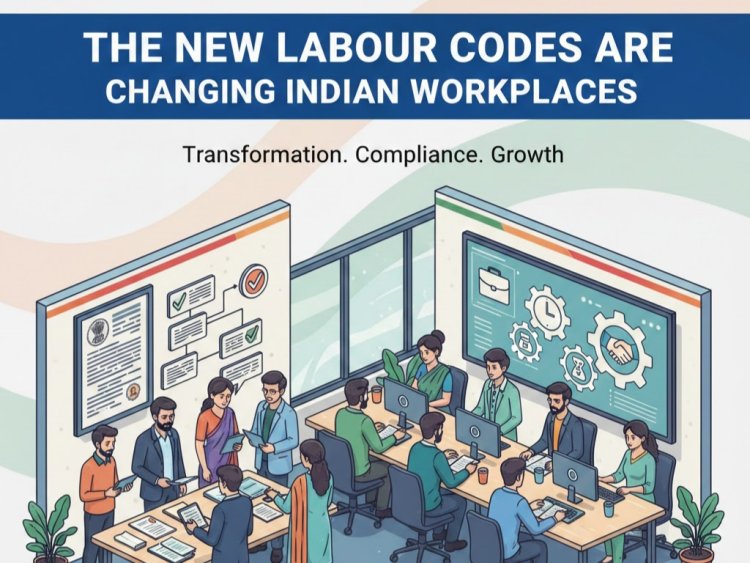
The New Labour Codes Are Changing Indian Workplaces
What Employers and Employees Must Understand Before Compliance Becomes Compulsion

Introduction: A Change Most People Are Underestimating
India’s labour laws were once a complex web of outdated regulations, overlapping rules, and unclear responsibilities. For decades, businesses survived by managing compliance reactively, often treating labour law as an annual paperwork exercise rather than a daily operational reality.
That era is ending.
The new labour codes are not just legal reforms. They represent a fundamental shift in how work is structured, monitored, and protected in India.
For employers, these changes introduce higher accountability and transparency. For employees, they promise security, clarity, and dignity at work.
But there is a truth few are discussing openly.
Businesses that do not adapt their internal systems will struggle. Employees who do not understand their rights and responsibilities will feel confused rather than empowered.
This blog explains what the new labour codes really mean, how they impact both sides of the workplace, and why structured systems are becoming essential rather than optional.
Read this fully. Labour compliance is no longer a legal topic. It is a business survival topic.
Understanding the New Labour Codes in Simple Terms
India has consolidated multiple labour laws into four comprehensive labour codes.
These codes focus on wages, social security, occupational safety, and industrial relations.
The intent is clear. Simplify compliance, standardize protections, and reduce ambiguity.
However, simplification at the policy level does not mean simplicity at the execution level.
In practice, these codes require businesses to maintain accurate records, transparent wage structures, formal employment documentation, and consistent reporting.
Manual processes and informal practices do not align with this new reality.
What the New Labour Codes Mean for Employers
For employers, the biggest change is accountability.
The new codes increase responsibility around wage definition, overtime calculation, social security contributions, working hours, and employee classification.
Errors that were once ignored or overlooked are now easier to detect and harder to justify.
Employers must ensure that employee data is accurate, updated, and auditable at any time.
This shifts compliance from a periodic activity to a continuous process.
Businesses that rely on spreadsheets, handwritten registers, or fragmented tools face higher risk.
This is where HRMS platforms become critical. They centralize employee records, automate payroll calculations, track attendance, and maintain compliance documentation.
An HRMS does not reduce responsibility. It reduces human error.
Wage Structure Changes and Their Psychological Impact
One of the most discussed aspects of the new labour codes is wage restructuring.
The definition of wages affects basic pay, allowances, provident fund contributions, and gratuity calculations.
For employers, this means rethinking compensation structures. For employees, it means understanding take home pay versus long term benefits.
Poor communication around these changes creates mistrust.
Employees often perceive restructuring as loss, even when long term benefits increase.
This is where transparency matters.
Organizations that use structured payroll systems within HRMS platforms can clearly show how wages are calculated, how deductions work, and how benefits accumulate.
Clarity reduces conflict. Confusion creates resistance.
Impact on Employees: Rights With Responsibility
For employees, the new labour codes strengthen rights around wages, social security, working conditions, and dispute resolution.
However, rights come with responsibility.
Employees must understand attendance policies, working hour norms, and compliance expectations.
Informal arrangements are being replaced by documented processes.
Employees who resist documentation or structured reporting may struggle in modern workplaces.
Organizations that use LMS platforms to educate employees about labour laws, workplace policies, and compliance expectations create smoother transitions.
Learning reduces fear. Awareness builds cooperation.
Working Hours, Overtime, and Compliance Discipline
The new codes introduce clearer definitions around working hours, rest periods, and overtime.
While flexibility is allowed, documentation is mandatory.
Employers must track attendance accurately. Employees must adhere to defined schedules.
Manual attendance tracking increases disputes. Automated systems reduce them.
HRMS platforms that integrate attendance and payroll reduce ambiguity. They create objective records that protect both employer and employee.
This shift from assumption based management to data based management defines the modern workplace.
Contract Workers and the End of Informality
One of the most significant impacts of the new labour codes is on contract and gig workers.
The codes extend social security and protection to broader categories of workers.
This increases responsibility for businesses that rely heavily on contractual labour.
Contractor management, worker records, and compliance tracking become critical.
Organizations that manage vendors and contract workers through structured systems gain clarity and control.
This also improves trust between businesses and their workforce.
Why Compliance Is Becoming a Cultural Issue
Compliance is often treated as a legal requirement. In reality, it is a cultural signal.
A compliant organization signals discipline, fairness, and professionalism.
Employees feel safer. Partners feel confident. Regulators feel assured.
Non compliant organizations signal risk.
The new labour codes amplify this distinction.
Businesses that embed compliance into daily operations outperform those that treat it as an external obligation.
This is why compliance driven technology adoption is accelerating.
The Role of Technology in Labour Code Readiness
Technology is not replacing human judgment. It is supporting it.
HRMS platforms help businesses manage employee data, payroll, attendance, and compliance documentation.
LMS platforms help educate employees and managers about policy changes, safety norms, and legal responsibilities.
CRM systems ensure that customer commitments align with workforce capacity and compliance norms.
POS systems support transparent wage and transaction records in retail and service environments.
Together, these systems create operational alignment.
Alignment reduces risk.
Psychological Resistance to Change and How to Overcome It
Change creates discomfort.
Employers fear increased cost. Employees fear reduced flexibility.
Resistance is natural.
Organizations that communicate clearly, train consistently, and implement systems gradually experience less friction.
Systems remove subjectivity. Subjectivity creates conflict.
When rules are applied through transparent systems, trust increases.
This psychological shift determines whether labour reforms feel empowering or oppressive.
What Small Businesses Must Do Now
Small businesses often assume that labour laws apply mainly to large organizations.
This assumption is dangerous.
The new labour codes extend applicability and enforcement gradually.
Small businesses that prepare early gain stability.
Implementing basic HRMS and payroll systems now prevents future disruption.
Educating employees through simple LMS modules builds awareness.
Waiting until enforcement intensifies increases stress and cost.
Preparedness is cheaper than correction.
Global Perspective: Why Labour Compliance Attracts Investment
International partners look closely at labour compliance.
Businesses with documented HR practices, transparent payroll, and structured training are seen as lower risk.
India’s labour reforms improve global confidence in Indian enterprises.
Businesses that align early gain access to better partnerships and opportunities.
Compliance is not a cost. It is a credibility asset.
The Role of Gomsu Information Technologies in Compliance Readiness
Gomsu Information Technologies builds platforms that help businesses transition smoothly into compliance driven operations.
Its HRMS solutions support payroll accuracy, attendance tracking, and employee record management.
Its LMS platforms help organizations educate their workforce consistently.
Its CRM and POS systems support transparency across customer and transaction workflows.
These platforms work together to reduce operational friction and compliance anxiety.
The focus is not complexity. The focus is clarity.
Conclusion: Labour Codes Are a Test of Maturity
The new labour codes test more than legal understanding.
They test organizational maturity.
Businesses that operate with structure adapt easily. Businesses that rely on informal practices struggle.
Employees who understand their rights and responsibilities feel empowered. Those who remain unaware feel uncertain.
The future of work in India belongs to organizations that combine fairness with discipline.
Systems make that balance possible.
Call to Action: Be Part of the Dialogue
Labour reforms affect everyone.
If this article helped you understand the new labour codes better, share it with employers, HR professionals, and employees in your network.
Comment with your experiences or questions.
Like and share to continue the discussion.
Strong workplaces are built through informed conversations
What's Your Reaction?